Blog · 26 October 2026
Pit latrine vs VIP latrine vs ecosan toilet: how to tell them apart in satellite imagery
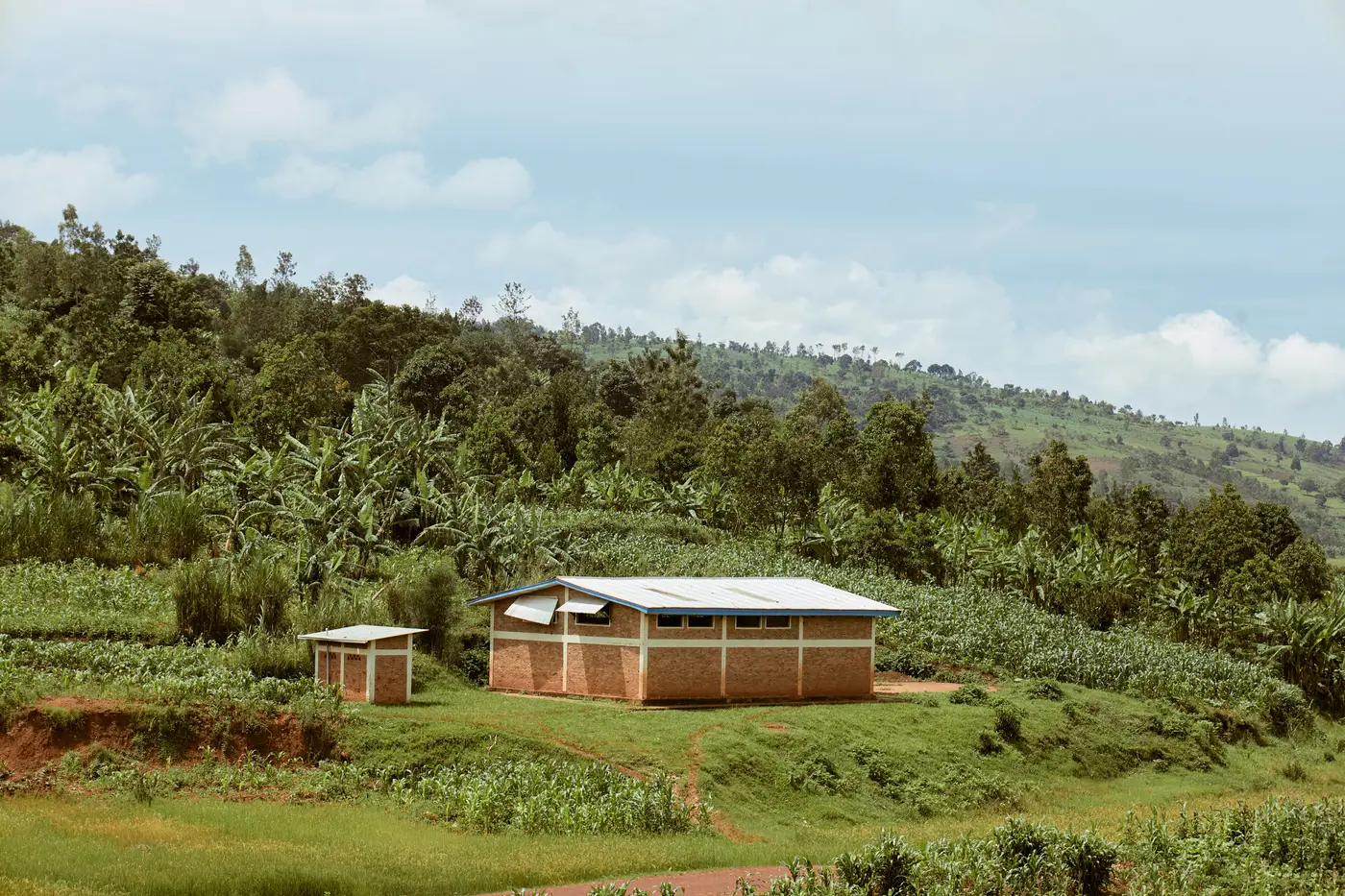
If you've ever tried to sort latrine blocks into pit, VIP, and ecosan from a satellite image before sending a team out, you already know the honest answer: imagery alone won't give you a clean split. What it will give you is a reliable count of where structures sit, which is most of what you need before a field visit anyway. Here's what you can and can't read off a 0.3 m pass, and where the line falls.
What shows up at 0.3 m
At very high resolution, you're reading roof outline, footprint size, shadow, and what sits next to the structure. That's the full toolkit. A pit latrine built from local materials usually shows as a small, single-pitch or flat-roofed footprint, often slightly askew to the compound layout, sometimes with a visible depression or disturbed ground where the pit was dug. No consistent roofing material, no consistent orientation. It blends into the compound rather than standing apart from it.
A VIP (ventilated improved pit) latrine shares that small footprint but tends to be uniform where a programme built several at once: same roof pitch, same orientation relative to prevailing wind, same rough dimensions across a cluster. Programme-built VIP blocks also cluster near a borehole or tank stand more often than informal pit latrines do, because they went in as part of the same water-and-sanitation package.
Ecosan (urine-diversion dry toilet) structures read differently again. They're usually raised on a plinth to allow the double-chamber vault underneath, which shows up as a slightly larger, squarer footprint with a visible step or ramp on one side. Where a programme has rolled out ecosan at scale, you'll often see a second small structure or extension beside the main block, housing the second chamber or the urine collection point.
The VIP vent pipe tell
The feature everyone asks about is the VIP vent pipe. In principle it's the single structural giveaway: a thin vertical pipe rising above the roofline, there specifically to pull odour and insects out through a fly screen rather than out the drop hole. In practice, catching it from directly overhead is hit-or-miss. A vent pipe that's 100-150mm across casts a short shadow at midday and almost none when the sun is close to overhead, which is exactly when most VHR tasking happens for cloud-free conditions in the tropics. You're more likely to pick it up as a faint shadow line off the roof edge in an early or late-pass image than as the pipe itself. Treat it as a confirming detail when the sun angle cooperates, not as something to count on every pass.
Latrine block identification: what works, what doesn't
One annual VHR pass lets you build a dated, located inventory of every structure matching a latrine block's rough footprint, clustered against boreholes and tank stands, across a district you'd otherwise have to walk. What it can't do reliably is hand you a clean pit-versus-VIP-versus-ecosan tag on every point. Roof material, pit disturbance, plinth height, and vent pipe shadow all help narrow the call, especially for structures built in a recognisable programme pattern. But construction quality varies enough, and sun angle varies enough between passes, that a desk-based type call should be treated as a working hypothesis for the field team to confirm, not a final classification.
That split matters more for planning than a clean type call does. Imagery tells you where every structure sits, when it last showed up in a pass, and which clusters warrant a first look. That's the part a single annual VHR pass over a district does well, and it's the gap between walking blind and sending a team somewhere with a reason. Sanitation Mapping turns that pass into exactly that: a point inventory of every borehole, tank stand, and latrine block the imagery shows, dated and exportable as GeoJSON or CSV, so the type call happens on the ground where it belongs.
If your district hasn't had a structure count run against it yet, that's the first thing worth fixing before the next field season.